
Islamic finance (also known as Shariah-compliant finance) is finance that conforms to the moral precepts of Islam.Islamic finance differs from conventional (Western) finance in its approach to money: it is based on the belief that money doesn’t have any intrinsic value. Instead, according to Islamic scholars, money should be seen just as a medium for exchanging products and services. Linked to this idea is a ban in Islamic finance on making money from money in the form of interest. Islamic finance also prohibits investment in goods or services seen as harmful. This prohibition covers activities such as the production and sale of alcohol, tobacco and gambling.
Another principle in Islamic finance is that of mutual and ethical partnership between the provider of finance and the entity receiving it. This means that the profits and risks of a business venture should be shared as far as possible, rather than one party claiming most or all of the upside or bearing the full risk of loss. In the Islamic finance partnership, losses and profits are often shared according to a pre-agreed ratio. Activities seen as permissible and desirable within Islamic finance are called ‘Halal,’ and those seen as prohibited are called ‘Haram.’ These halal and haram interpretations are made by Islamic scholars on the basis of three primary sources: the Qur’an, the Hadith (The sayings of the Prophet Muhammad), and the Sunnah (the practice and traditions of the Prophet Muhammad).
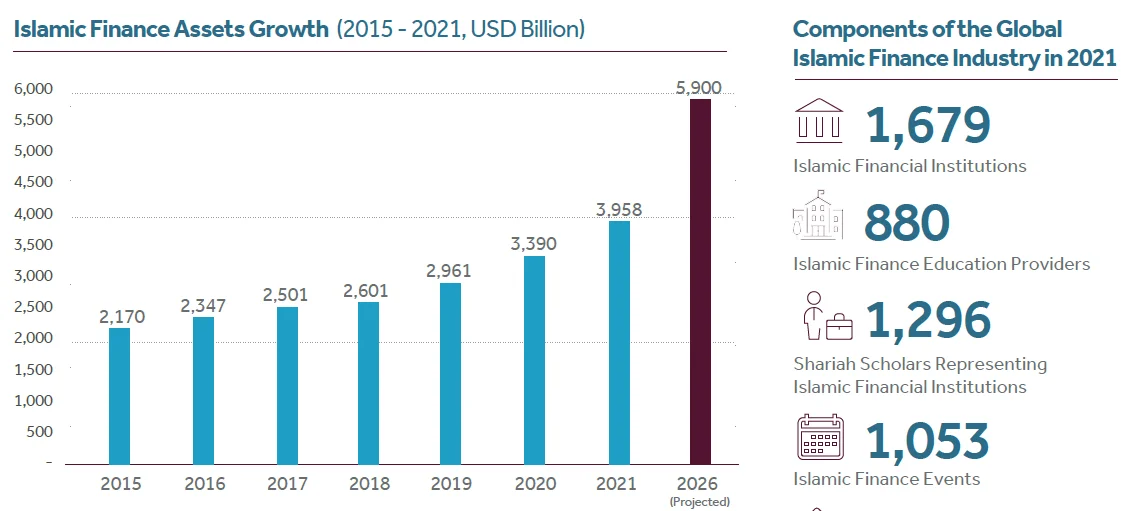
Islamic finance is a rapidly growing part of the global financial markets. According to Refinitiv, global Islamic finance assets grew from $2.17trn in 2015 to $3.96trn in 2021 and are forecast to increase to nearly $6trn by 2025.
These assets are held largely by the Islamic banking system (70 percent of the total) and in Sukuk (Shariah compliant bonds). Islamic funds, other Islamic financial institutions and Takaful (a Shariah-compliant alternative to conventional insurance) make up the remaining 12 percent of the total assets in Islamic finance.
Pak Rizk is committed to promoting ethical and Shariah-compliant investment solutions that align with Islamic values. We empower individuals and businesses to grow their wealth responsibly, with transparency, integrity, and a focus on lasting impact.
